With in-person tickets fully booked and viewers joining online via livestream, the event marked the start of several weeks of science, arts and future-focused programming across Swindon and the surrounding area.
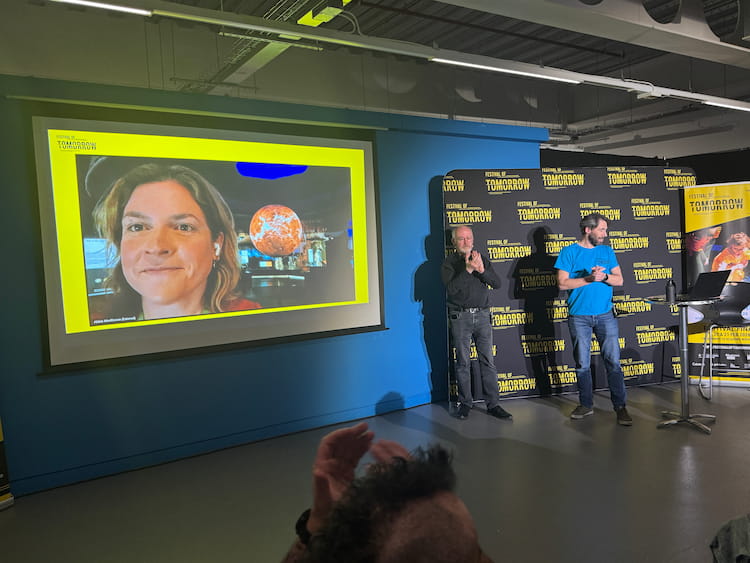
The evening focused on humanity’s return to the Moon for the first time since the Apollo programme. Doug Millard from the Science Museum guided audiences through the original space race and the new global competition to dominate space.
A live after-hours link to Abbie MacKinnon inside the Science Museum’s Destination Space gallery offered a rare behind-the-scenes insight.
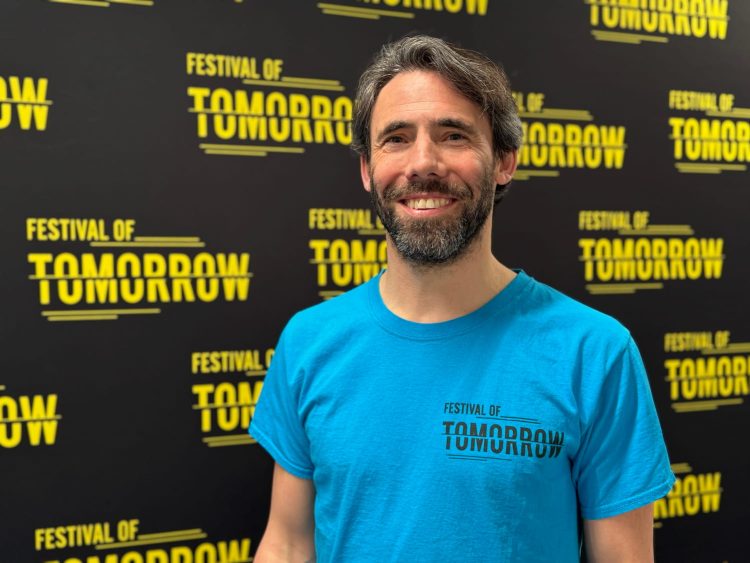
Festival of Tomorrow Director Rod Hebden said the evening represented more than a talk about space.
“It’s been going brilliantly,” he said. “This is the first time we’ve done this partnership with the Science and Innovation Park, which people might know as the home of the Science Museum collections up at Wroughton. We wanted to test whether we could use this amazing facility, get behind the scenes, get people up the hill and into the brand new Hawking Building.”
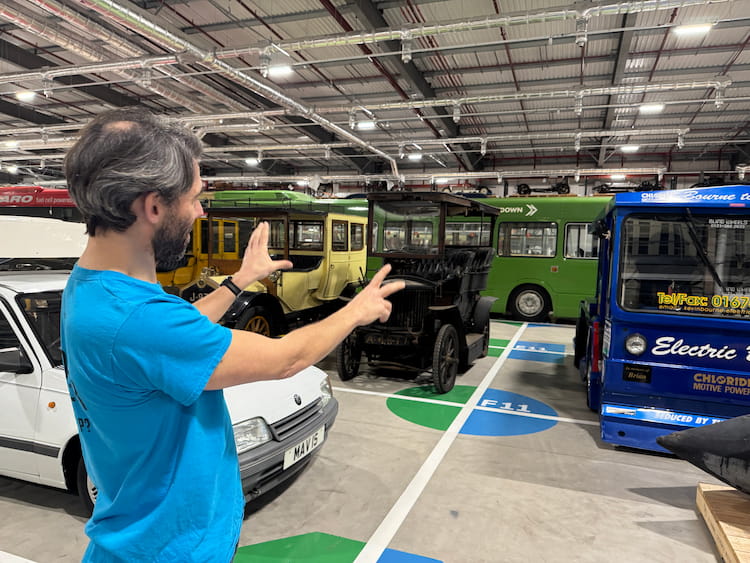
He pointed out that around 353,000 objects are housed at the site, many rarely seen by the public.
“There’s a different thing for every person,” he said. “For most people, a bit of reinforced concrete is just a lump of concrete. But for a civil engineer it can be mind-blowing. Every object here tells a story about us, how we saw the future, what we thought was important. When you look at the real thing, it brings it to life.”
Among his personal highlights is Spacelab 2, an X-ray telescope that travelled into orbit aboard the Space Shuttle Challenger and returned to Earth.
“Not many things go into space and come back,” he said. “You can stand right next to this bit of kit that’s been in space and back. That’s powerful.”
The festival has adopted a hybrid format this year, combining live studio audiences with online streaming and remote links to national institutions.
“We’ve made each of these events hybrid,” Rod explained. “We’ve gone live online on YouTube, and we’ve gone behind the scenes in many places. Earlier this week we were at a robotics house, we’ve been up to Bradford at the media museum, and we’ve toured a lab where they’re growing meat. There’s a lot of tech involved, but it’s been really well received.”
Despite its strong scientific focus, Rod said the event is not positioned as a traditional science festival.
“If I’m pushed, I call it a science and arts festival,” he said. “If you call it a Science Festival, people think it’s for people interested in science. But actually it’s equally, if not more, for people who don’t realise they’re interested in science.”
This year’s programme reflects that breadth. Installations at STEAM the Museum of the Great Western Railway, invite visitors to explore the workings of the human mind, including immersive light pieces examining anxiety and perception.
The finale at the Swindon Deanery will feature large-scale shows from Wonderstruck, alongside theatre exploring what it means to be normal and conscious in an age of artificial intelligence.
“There really is something for everyone,” Rod said. “From surveillance and disease tracking to arts and crafts for families. Go on the website, filter by age group, and you’ll find your thing.”
For Rod, the festival has particular significance in a town without its own university.
“For a place like Swindon, it’s great to bring all that expertise in and expose people to it,” he said. “You can’t do what you don’t see. We don’t try to raise aspirations for young people, we try to broaden them. Kids already have aspirations. We just want to show them everything else that’s possible and let them fill their boots.”
As NASA prepares to send astronauts back to the Moon, organisers hope residents across Wiltshire will look ahead and engage with the bigger questions about the future.