
Ben Bell, coordinator of eco-campaign group, Plastic Free Swindon, believes tackling environmental problems requires society to move away from a culture of constant consumption and replacement.
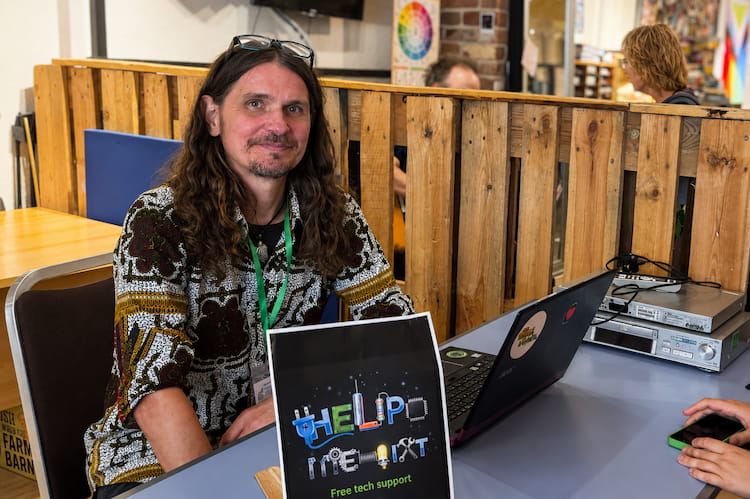
Speaking from the Swindon Hub where he volunteers at a free IT support group, Ben said the environmental message he has developed through more than eight years with Plastic Free Swindon goes significantly further than recycling.
“We need to reduce plastic production” he said.
“We need to look at the waste hierarchy, especially important when it comes to plastics; reduce, reuse, repair, refashion, remanufacture.”
Ben argues that recycling should not be regarded as the end solution to plastic pollution.
“Recycling is not right for plastic pollution,” he said. “We need to do better.”
That philosophy can already be seen in his work in Swindon. Through Help Me IT at the Swindon Hub, Ben and others take unwanted technology and attempt to keep it in use rather than allowing it to become electronic waste.
“We reuse and repair and refurbish old laptops, especially old phones,” he said.
The project has also used refurbished equipment to support people within the Swindon community.
“There’s a lot of people who are refugees in the Hub, especially, we’ve helped them with old laptops, and it’s a joy to do,” Ben said.
For him, the environmental benefit is straightforward.
“This is not waste. This is reducing waste.”
Help Me IT also provides free technology support and gives people in Swindon an opportunity to share their own knowledge.
“We take in donations, repair, refurbish,” Ben said.
“We get people come in, sit down with us, have a chat, a cup of tea, and then people share their skills.”
But Ben’s environmental argument stretches beyond old computers and phones.
He believes Swindon residents can also use their spending power to support a more sustainable local economy.
“Support local, independent, and organic,” he said.
Ben pointed to food shopping as one of the clearest examples.
When asked whether buying fruit and vegetables from a local greengrocer, avoiding unnecessary plastic and using reusable bags was the kind of change he wanted to see, he replied:
“That’s one of the most powerful things we can do in terms of food. Yeah, absolutely.”
He argues that buying locally can have wider environmental benefits, including reducing unnecessary packaging and considering the distance products travel before reaching consumers.
“You think about food miles, you think about transport noise of all these lorries, planes, or ships,” he said.
His wider message is that environmental action in Swindon does not have to begin with national legislation or major infrastructure projects.
It can start with decisions made within individual homes and communities, whether that means repairing an old laptop, passing unwanted technology to somebody else or choosing to spend money with an independent Swindon business.
“Get involved, spread information, positivity,” Ben said when asked what the local community could do.
“Places like this, we’re in the Swindon Hub, so there’s lots of nice community here, nice people.
“Get together, do nice things. You know, things that really matter, I think, for community.”
For Ben, bringing people together is central to achieving wider environmental change.
“We need to build local efforts,” he said.
And his work at the Swindon Hub provides a practical example of what he means, keeping technology out of the waste stream, sharing skills and encouraging people to consider whether something really needs replacing before it is thrown away.
Ben is also involved in Keep Swindon Tidy and Refill Swindon.
.