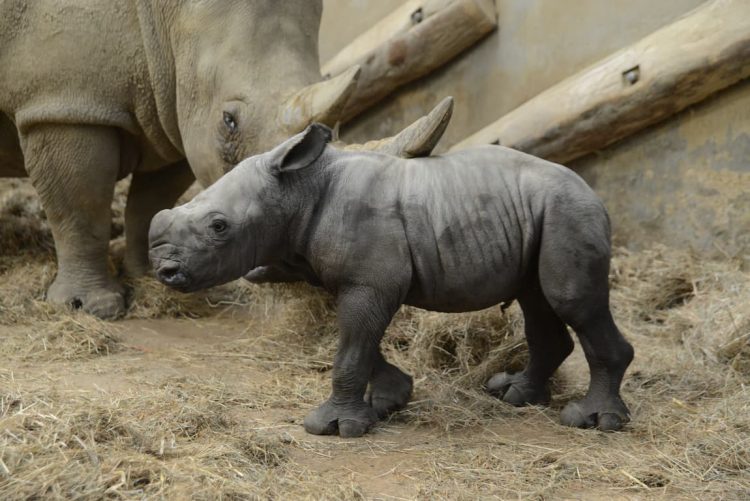

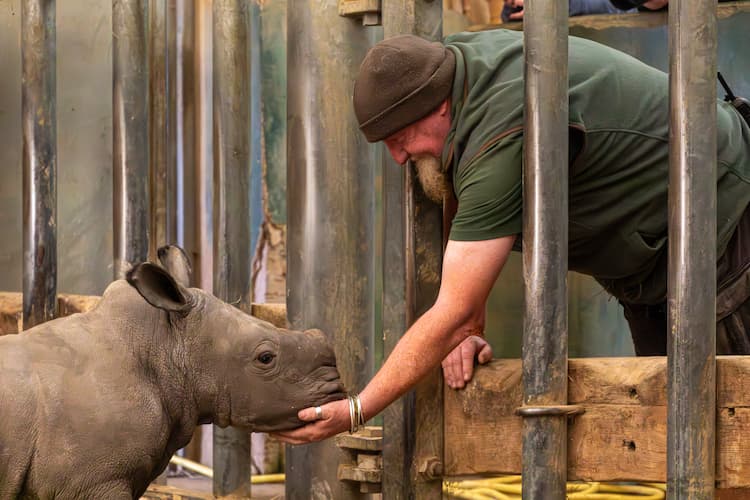
The male calf, named Markus, arrived at the Burford-based park earlier this month. His birth marks the twelfth successful Rhino birth at the park in as many years – a significant achievement for conservation in captivity.
The new arrival was born to experienced mother Nancy and breeding male Monty. It is Nancy’s seventh calf.
Keepers were present at the time of the birth, which is unusual for Rhino deliveries, as they typically occur overnight. The birth took just under 45 minutes.
Mammal Keeper Liam Klingsick filmed the moment, and Head Keeper Mark Godwin, who has looked after the park’s Rhinos for twelve years, also witnessed the birth.
Mark said:
“He’s one of most confident calves I’ve seen.
“Newborns weigh approximately 70kgs at birth and put on roughly 1.5-2kgs a day in weight.
“If he grows into his features, he will be a big lad.”
White Rhino births remain rare across Europe. Only five calves have been born in zoological collections across the continent this year.
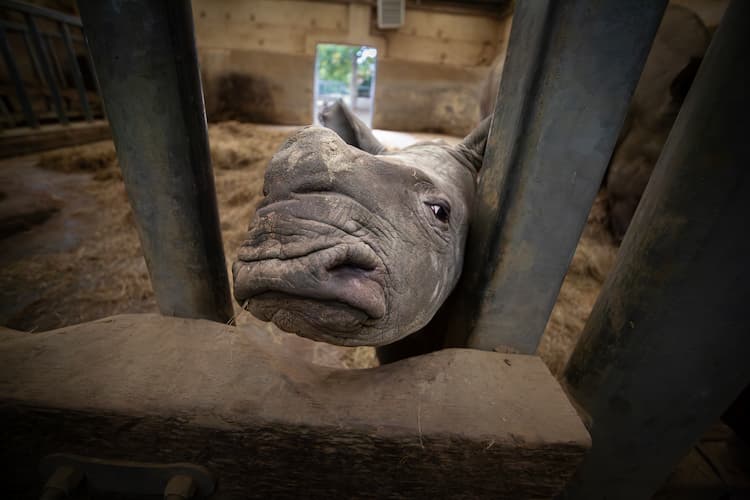
Markus was named in honour of the late Dr Markus Borner, a leading conservationist who played a major role in the recovery of Tanzania’s Black Rhino population.
Reggie Heyworth, Chairman of Cotswold Wildlife Park and Gardens, said:
“We have named our new arrival, Nancy’s seventh calf, Markus after the late Doctor Markus Borner.
“He gave me my break into conservation when he was head of Frankfurt Zoological Society in Tanzania.
“It’s a long story but basically, he appointed me project leader of FZS’s Tanzania Rhino Conservation Programme in 1992.
“It sounds grand but in fact at the time there was a known population of only 12 Black Rhinos in northern Tanzania and maybe a couple of dozen dotted around the rest of the country, mostly in northern Selous Game Reserve in the southeast of the country.
“So there remained maybe 50 in total in the whole country, from a population of 20,000 in 1970 (very roughly estimated).
“The rest had all been wiped out by poachers in the 1980s.”
Reggie continued:
“In other words, everything was on the floor and the only way was up.
“By the time Markus died in 2020, Tanzania’s Serengeti ecosystem had substantially been re-populated with a potentially viable population of Black Rhinos and I’m not the only one who would find it difficult to think of anybody else who had more of a positive influence on that outcome than Markus Borner.
“He was not only a giant of conservation but also my incredibly supportive boss and he became one of my best friends.”
Dr Markus Borner was awarded the Blue Planet Prize in 2016 for his work in conservation science.
With Markus’s birth, the park is now home to eight White Rhinos – the largest number it has ever had on show at one time. Keepers believe they may also have captured the calf’s conception on camera.
The young Rhino has already become a visitor favourite, entertaining crowds with his energetic behaviour.
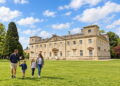
Markus can be seen daily in the park’s solar-powered Rhino House or in the large paddock overlooking the Manor House, from 10am.
Cotswold Wildlife Park works closely with the UK charity Tusk to support Rhino conservation efforts in Africa. The park has raised over £120,000 for Tusk in the past decade.
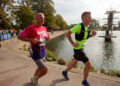
In 2021, Reggie Heyworth raised more than £12,000 for the charity by running the London Marathon.
More information on Tusk is available at www.tusk.org