
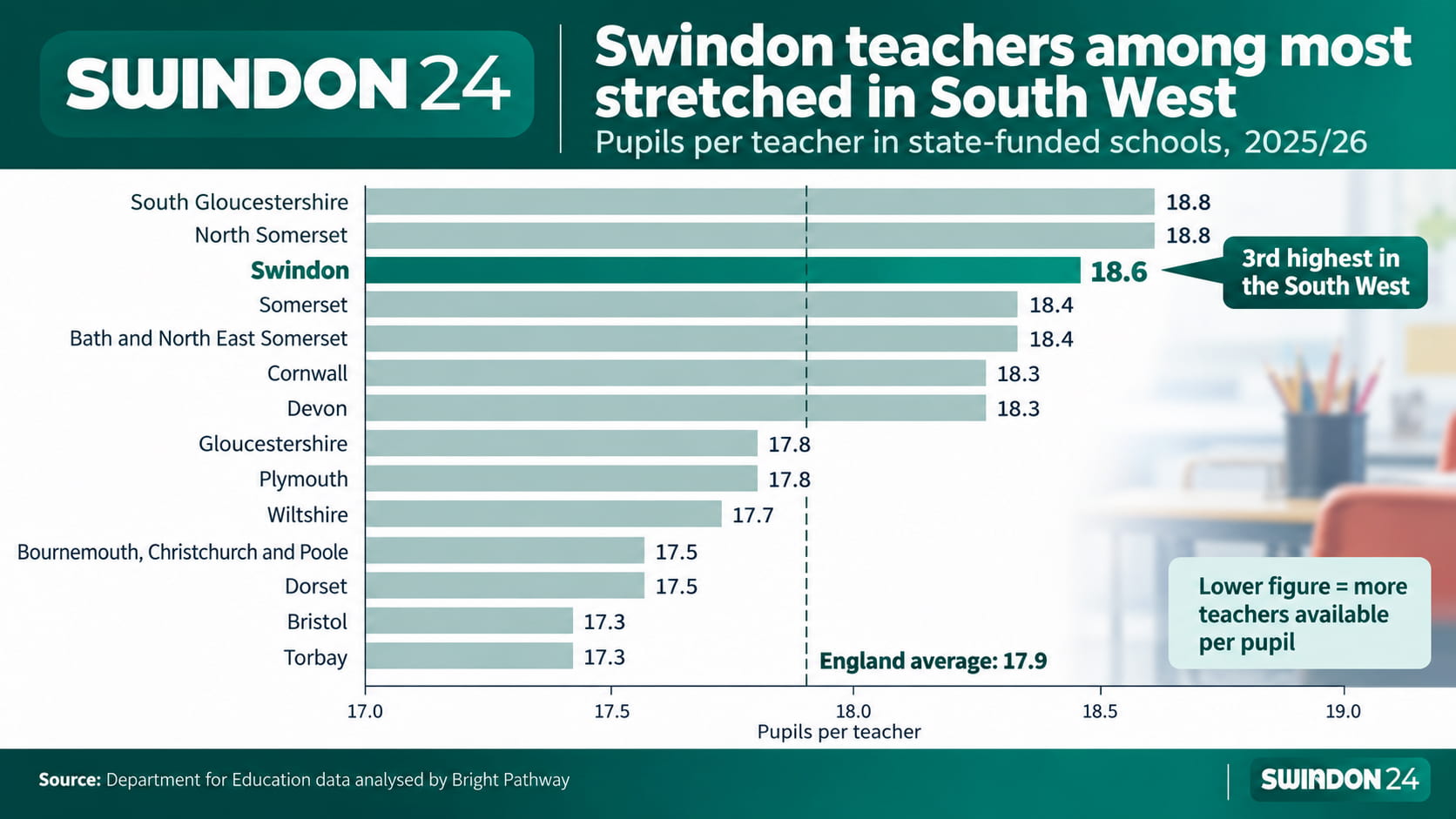
The town has 18.6 pupils for every teacher across its 88 state-funded schools, the third-highest ratio among local authority areas in the region.
Only South Gloucestershire and North Somerset recorded higher figures, both with 18.8 pupils per teacher.
Swindon’s ratio is also above the England average of 17.9 pupils per teacher.
According to the study by vocational training provider Bright Pathway, Swindon’s state-funded schools have a combined 36,831 pupils and 1,976 teachers.
Neighbouring Wiltshire has a notably lower ratio, with 17.7 pupils for every teacher across 235 state-funded schools, covering 68,583 pupils and 3,885 teachers.
The figures do not represent average class sizes. The analysis counts all teachers employed by state-funded schools, including those who may not be timetabled to teach a particular class.
Instead, the figures provide an indication of the overall number of teachers available in relation to the pupil population. Across the South West, South Gloucestershire and North Somerset recorded the highest ratios at 18.8, followed by Swindon at 18.6.
Somerset and Bath and North East Somerset both recorded 18.4 pupils per teacher, while Cornwall and Devon stood at 18.3. At the other end of the regional table, Bristol and Torbay recorded the lowest ratios, with 17.3 pupils for every teacher.

The gap between the highest and lowest ratios in the South West was therefore 1.5 pupils per teacher. Nationally, the analysis found Barnsley had the highest pupil-to-teacher ratio in England, at 19.9, while Camden had the lowest at 14.5.
Bilal Ahmad, founder and director of Bright Pathway, said the figures showed that the size of a local authority’s pupil population did not necessarily determine how stretched its teaching workforce was. He said:
“Looking at pupil numbers alone does not give a full picture of the resources that are available to schools.
“An additional pupil per teacher across an entire authority can mean significantly less one-to-one attention over the course of a school year.
“Schools will always need to prioritise access to qualified teachers in order to provide pupils with the individual support they need.”
The study analysed the Department for Education’s latest School Workforce in England data for 2025/26.
Researchers divided the number of pupils attending state-funded schools in each local authority by the total number of teachers. Only areas with at least 10 state-funded schools and 5,000 pupils were included.