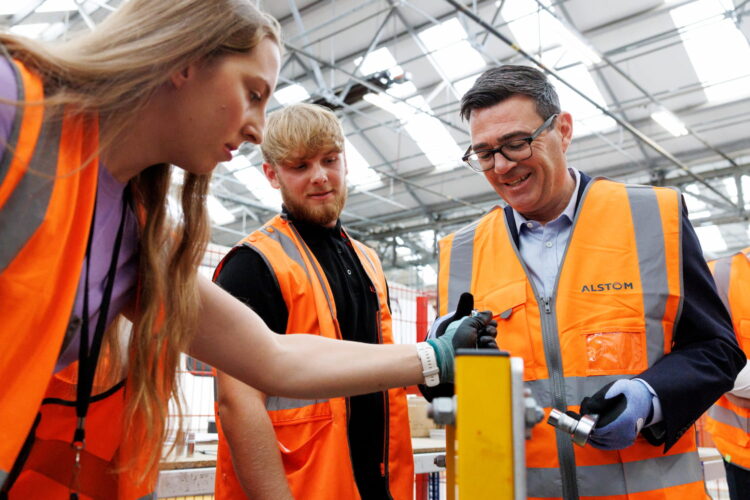

The reforms are designed to place vocational education on the same footing as university, giving young people clearer routes into skilled employment while helping employers recruit workers for sectors facing long-term shortages.
Announcing the plans, Mr Burnham said Britain would now value “the hard hat as much as the graduation cap” as ministers set out proposals to reshape technical education.
The changes come as the number of people aged 16 to 24 who are not in education, employment or training has risen above one million across the UK.
Under the proposals, pupils will be able to begin technical education from the age of 14. They will study core subjects alongside industry-led projects, work experience and qualifications linked to local employment opportunities.

The Government also plans to invest £287 million to create more than 22,000 additional college places, introduce apprenticeship bursaries worth up to £4,500 for eligible families, expand Youth Hubs across England and continue its ambition to create 50,000 additional apprenticeships during this Parliament.
The announcement could be particularly significant for Swindon, where advanced manufacturing, engineering, aerospace, defence and technology industries have repeatedly highlighted shortages of skilled workers.
Swindon Borough Council said many of the principles behind the reforms are already being delivered through local initiatives.

Councillor Kate Tomlinson, Swindon Borough Council’s Cabinet Member for Children and Education, said:
“Swindon is already taking a joined-up approach to ensuring local people have the skills employers need, particularly in growth sectors such as advanced manufacturing, engineering, digital and defence.
“Through our new Skills Strategy and Skills Board, we are bringing together employers, schools, colleges, universities, government agencies and business groups to better connect education with the needs of the local economy.
This includes stronger employer engagement in schools, industry-led projects, apprenticeships, Skills Bootcamps, T Levels and specialist STEM education through Swindon UTC and the Institute of Technology. These initiatives help young people understand the wide range of career opportunities available locally and give them clearer pathways into employment.”
The council said around 93% of young people in Swindon already progress into education, employment or training, while the proportion whose destination is currently unknown stands at 2.6%.
She added:
“The challenges around young people who are NEET are complex and reflect a range of national and local factors. We welcome any discussion about how to better support young people, but our focus remains on practical action that improves transitions into employment, raises aspirations and ensures employers can access the skilled workforce they need.”

North Swindon MP Will Stone welcomed the announcement and said he had been campaigning for greater support for apprenticeships and vocational education.
“I have been arguing for greater expansion of apprenticeships and vocational education for some time now and have been working with Swindon companies to bring in more apprenticeships and am pleased that STARK and others have already started to take on apprentices,” he said.
“The Prime Minister is right to mark equivalence between university and vocational education. I never went to university and know how valuable learning on the job can be to build resilience and skills.”
Mr Stone said he wanted to continue working with New College Swindon and local businesses to strengthen technical education across the town.
“I would like to see some of this enhanced Swindon offer delivered through apprenticeships, technical training whilst some will be through degree awarding powers. My focus is on ensuring that we nip the NEET crisis in the bud, giving young people the opportunities and support they require to thrive.
“I’ve had the privilege to meet many young people in this role and within each I’ve seen a burning passion to succeed and build a better life for themselves and their family. It’s my job, and the job of this new Government, to support them and let them succeed.”

Mr Stone also repeated his call for employers’ National Insurance contributions to be reduced for businesses hiring under-25s.
“I have met with a number of businesses who need the support of the state to take a risk on young people who may not yet have held a full-time job and the best way to do that in my view is to reduce the costs of employing those individuals, not in the wage they receive, but in the expenses to the business,” he said.
The Government said the reforms will be introduced from 2028, with ministers hoping the changes will better align education with the needs of local economies and future industries.