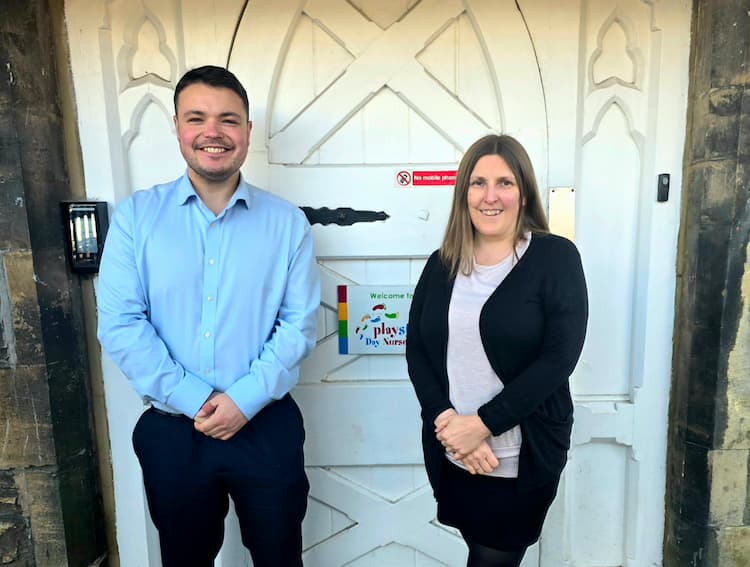

Jake Chandler, Shadow Cabinet Member for Children’s Services and Education at Swindon Borough Council, has written to Education Secretary Bridget Phillipson after meeting local childcare providers.
He argues that nurseries are delivering a public service but are taxed as private businesses.
At the centre of his concerns is what he describes as an imbalance between nurseries and schools.
Schools providing similar educational and developmental support do not pay business rates, while nurseries do, despite delivering a significant share of Government-funded childcare.
“That’s the inconsistency providers keep coming back to,” Cllr Chandler said. “You’ve got two parts of the education system delivering similar outcomes for children, but only one is being taxed like a commercial operation.”
Early years providers are heavily regulated, cannot freely set prices and are required to deliver Government-funded childcare places. However, they remain liable for property-based taxes that schools are exempt from.
“If Government sees early years as education, then it needs to treat it like education,” he added. “At the moment, it’s stuck in the middle, expected to deliver a public service, but funded and taxed like a private business.”
He also raised concerns about how business rates are applied.
Some nurseries operating from community buildings, such as church halls, benefit from exemptions. Others operating from purpose-built premises do not, despite offering the same services.
“I’m not arguing that anyone should lose the relief they already have,” he said. “But it can’t be right that two settings doing the same job are treated completely differently depending on the building they operate from.”
Cllr Chandler said recent changes linking rates more closely to floor space have increased pressure on providers.
Nurseries must meet legal minimum space requirements per child and cannot reduce their footprint without breaching regulations. This, he said, leaves them particularly exposed to property-based taxation.
He added that providers are unable to offset rising costs by increasing fees.
Government-funded childcare rates are fixed, and additional charges for items such as meals or activities must be voluntary. He said many settings absorb those costs to remain compliant and inclusive.
“Providers are telling me they’re having to make impossible decisions,” Cllr Chandler said. “They can’t pass costs on, they can’t reduce their space, and they can’t opt out of delivering funded places. Something has to give.”
He questioned whether the current system can be described as a functioning private market.
“I don’t think anyone looking at this honestly could say this is a normal market,” he said. “It’s a highly regulated system with very limited freedoms, but without the protections you’d expect from a public service.”
Cllr Chandler said removing business rates would not solve every challenge facing the sector but would ease immediate financial pressure.
“This is one of the simplest changes Government could make,” he said. “It wouldn’t fix everything, but it would take real pressure off settings straight away.”
He warned that without intervention, providers could begin to close or reduce capacity.
“We’ve got fantastic providers in Swindon delivering really high-quality care and education,” he said. “But they’re being squeezed from every angle.
“If we don’t address this now, the risk is that provision starts to shrink, and once those places are gone, they’re incredibly difficult to replace.”