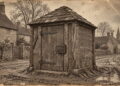
When I was asked to write for Swindon 24 about what I have learnt from living and working overseas, my mind drifted to an old Chinese story about a frog at the bottom of a well (for those interested: Jǐng dǐ zhī wā 井底之蛙). In an instant, I was back in my childhood, searching for frogs and tadpoles in a stream at Lydiard Park (there was no lake then).
The age-old story goes like this: The frog looks up and sees a small circle of sky overhead. To the frog, that circle is the whole world. It cannot imagine that beyond the walls of the well lie mountains, oceans, forests and entire civilisations.
Sometimes I wonder whether Britain, yes, even Swindon, has become a little like that frog.
Not stupid. Not lazy. Just trapped within a very narrow horizon.
I’ve spent much of my life working overseas, particularly in East Asia, before returning to Swindon in 2020 for family reasons. One thing that struck me was not just the differences in economics, politics or architecture, but the way societies think about time.
China asks: “What does the nation need in 30 years?” They think in generations and act quickly.
Britain asks: “What can survive the next election?” We think short-term, yet we act slowly.
Now, before anyone spills their tea (which, I should add, originally came from China) in outrage, let me be clear: Churchill famously observed that democracy is the worst form of government, except for all the others. I would agree.
Democracy matters. Freedom matters. Debate matters.
But let’s also be honest with ourselves.
Trying to build long-term infrastructure or a national strategy in Britain can sometimes feel like driving a coal-powered freight train while the tracks are being laid, one section at a time, by committees arguing over the direction.
One government announces a grand vision.
The next government rebrands it.
The third cancels it.
By the fourth, we’re back where we started, but with a glossy consultation document and a new logo.
Meanwhile, countries planning 30, 40 or 50 years ahead are quietly building ports, railways, energy systems and entire new cities.
What is interesting, however, is that Britain may be slowly rediscovering strategic thinking. The UK Government’s June 2025 The UK’s Modern Industrial Strategy paper admitted that many investors view Britain as “too slow, uncertain, and expensive” when it comes to getting things built. That is an astonishing statement to find in an official government document.
To me, it signals Britain quietly moving back towards industrial policy, infrastructure coordination and longer-term planning. Fifteen years ago, that would have sounded almost un-British politically.
But perhaps we should ask ourselves a more personal question:
Have we become so consumed by current challenges that we struggle to properly imagine the future?
This matters for towns like Swindon because real change rarely begins with governments alone. It begins with the horizons ordinary people choose to imagine, and that has a ripple effect.
Swindon has always occupied an unusual position. Industrial. Pragmatic. Hard-working. Built on engineering, enterprise and connectivity. A railway town that once helped power Britain itself.
Yet today, uncertainty hangs over many British towns. We hear endless talk of regeneration, investment and levelling up, but often struggle to define what we actually want our towns to become.
A retail centre? A commuter hub? A cultural destination? A logistics corridor? Luxury flats with artisan coffee? Or simply a place where ordinary people can still build meaningful lives?
Globalisation further complicates this.
We want investment, opportunity and international connectivity. Yet at the same time, people fear losing identity, community and local character.
Both instincts are understandable.
Years ago, while trekking through Malaysia’s ancient rainforests, something struck me: a healthy forest needs giant trees reaching skyward, but if the canopy becomes too dense, no sunlight reaches the smaller shoots below. Growth at the top alone cannot sustain the whole ecosystem.
Local economies function similarly.
Large investments matter. Big projects matter. But so do local traders, grassroots culture, public spaces, independent food and beverage establishments, youth clubs and community centres. These are the invisible social glue that holds communities together.
Economists struggle to measure such things because not everything valuable fits neatly into a spreadsheet. Yet anyone who has travelled knows immediately when they encounter a place with soul. This is the unseen, and one could call it the sacred economy.
Equally, anyone who has walked through a dying town centre knows the opposite feeling as well.
Perhaps what Swindon and Britain more broadly need is not simply new politics, but a wider horizon. National and local government still matter, but their role should be to create the conditions in which hard-working and entrepreneurial people can fulfil their potential, ensuring enough light reaches the smaller shoots beneath the canopy so they too can grow, flourish, and strengthen the wider community through the goods, services and ideas they create.
A change in thinking, not just from government but within ourselves.
Because the real question is not simply what we are building next, but what kind of civilisation we are trying to leave for future generations.
The frog in the well saw only a circle of sky. Yet unlike the frog, which must climb out of the well to discover the true horizon, we need only lift our gaze beyond the walls around us to imagine what might be possible.
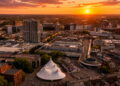
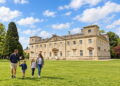
From the ancient Ridgeway and the Marlborough Downs in the south to the Roman Fosse Way in the north, and from the Oasis and Kimmerfields to the David Murray John Building, the Railway Village, the Mechanics’ Institute, Signal Point, Coate Water and Lydiard Park, the historic foundations of that future are already all around us.
So I will end with a simple question: what is your vision for Swindon?
Text and illustrations © 2026 Linus MacLiu. All rights reserved.
Illustrations conceived and directed by the author and created using AI-assisted image generation.
Photographs by Well: Niloofar Kanani. Rainforest: Justin Severus, Frog: Alan Emery. Word count 884