
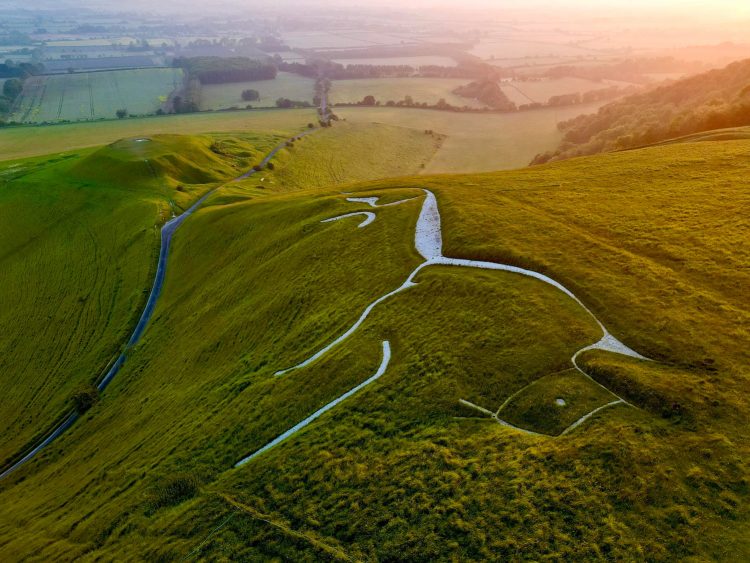

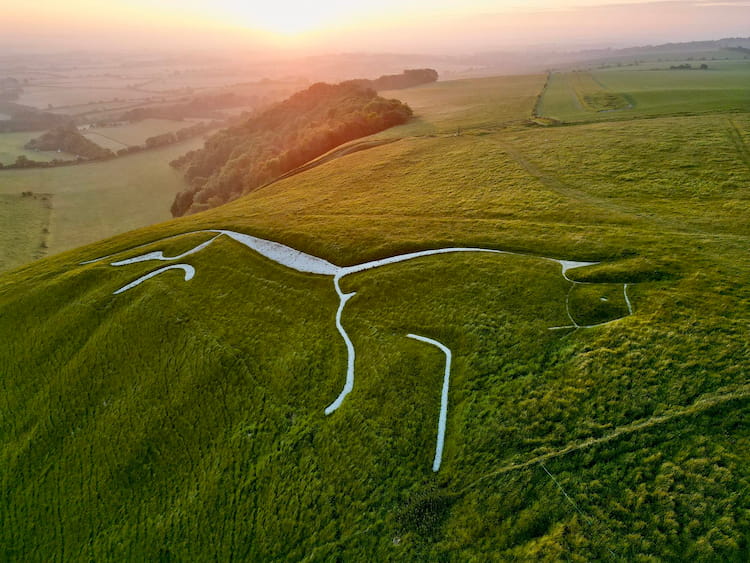
The Uffington White Horse is one of the most important prehistoric monuments in the country. Archaeological dating shows it was cut into the chalk more than three thousand years ago, making it far older than many other chalk figures found across southern England.
Unlike later carvings, the horse has survived through centuries of careful upkeep. Generations of local people have taken part in scouring the chalk, an act of communal care that has kept the figure visible against the hillside.
Local historian Royston Cartwright has spoken about the significance of the area for people living nearby. Writing on Facebook, he said: “We Swindonians are amongst the luckiest people in the land, our town is surrounded on all sides by so much history that it is staggering to try and comprehend it all.”
That sense of history becomes clear when you reach the top of the hill. Views stretch for miles across Oxfordshire and Wiltshire, with modern landmarks like wind turbines highlighting the age of the landscape beneath your feet.
Cartwright also points to the legends that continue to surround the site. He said: “Legend has it that the blood of the Dragon is still seeping out of the ground and killing the grass. Well have you got a better reason to explain why no grass grows there.”
The White Horse is only part of what makes the walk worthwhile. The hill is topped by the remains of Uffington Castle, an Iron Age fort whose earthworks still trace ancient boundaries.
Nearby, along the Ridgeway, is Wayland’s Smithy. The burial chamber is wrapped in folklore, with stories claiming travellers once left a coin and returned to find their horse newly shod.
The wider area is also linked to early English legend. Medieval tradition associates the landscape with King Alfred and his battles against Viking forces, stories that have become part of how the area is remembered.
After the walk, many visitors head into the village of Uffington. The small local museum, run entirely by volunteers, offers insight into rural life and the area’s long history.
Cartwright praised the museum for what it offers. He said: “It may be small but it packs one hell of a punch for its size. Free to get in but you would have to be a very mean person not to put a few pounds in the collection box as everything here is done by volunteers.”
Exhibits range from archaeology to social history, including a recreated Victorian classroom. Visitors can sit at the desks and get a sense of how education once looked for children in rural villages.
What makes White Horse Hill especially striking is how close it is to Swindon. Within a short drive, it is possible to walk through thousands of years of history and still be home within the hour.
For anyone wanting to better understand the roots of the area, the Uffington White Horse is not just a day out. It is a reminder that long before modern roads and housing estates, people were shaping and caring for this landscape.










You are free to use any of my posts, just give me a credit each time, I do one every Saturday and have done for the last 20 years
Uffington White Horse – with a side-walk to Wayland’s Smithy makes for a great walk and morning or afternoon out; but unless you’ve a helicopter I more than doubt the journey time as being “10 minutes” from Swindon. [any part thereof] Even from Bishopstone village – it is 10-15 minutes by car – to a car park some distance on foot from the hill-fort and horse (dragon)