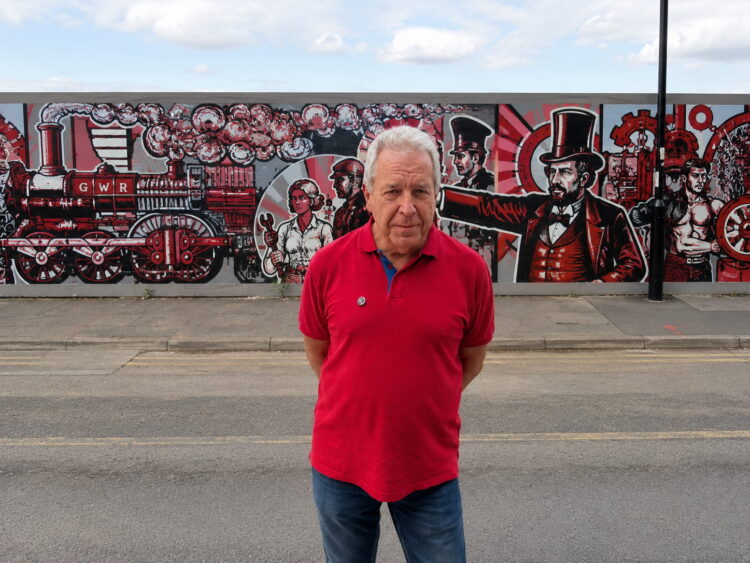

“If you opened me up, it would say Swindon inside me.” It’s a simple statement, but one that perfectly sums up Graham Carter’s lifelong passion for the town he has spent decades researching, celebrating and championing.
Known to many as one of Swindon’s foremost historians, Graham has dedicated years to uncovering the stories that have shaped the borough, from the rise of the Great Western Railway Works to preserving the legacy of homegrown band XTC. But while he is passionate about the town’s past, he believes its future is just as important.

Speaking exclusively to Swindon24, Graham said Swindon should take far greater pride in its heritage while recognising that its greatest strength has always been its ability to welcome people from across the world.
“Swindon keeps on reinventing itself,” he said.
“It started as a market town, became one of the greatest railway towns in the world, then we had companies like Honda, and now we’re seeing new industries coming in. There’s always another chapter.”
For Graham, that constant reinvention is what has defined Swindon for almost two centuries. He points to the arrival of the Great Western Railway Works in 1842 as the single most significant moment in the town’s history, transforming a small settlement into one of Britain’s industrial powerhouses.
“The first steam locomotive to travel at 100 miles an hour was built in Swindon,” he said.
“The engineering that came out of this town changed the world.”

Yet Graham believes too many people overlook those achievements.
He says Swindon has an extraordinary story to tell but often fails to celebrate it in the same way as other historic towns and cities.
“There are so many stories here that people don’t know,” he said.
“We should be proud of what we’ve achieved.”
Swindon’s history has always been one of migration and new beginnings. Railway workers arrived from every corner of Britain during the Victorian era, and in more recent decades the town has become home to communities from across Europe, Asia, Africa and beyond.
“It doesn’t matter where you’re from,” Graham said.
“You’re part of Swindon’s history.”

Hugh Llewelyn
He believes that message should sit at the heart of the town’s future, particularly as Swindon continues to promote its cultural identity.
“I’m really begging them to make it not just the City of Culture, but the City of Multiculture,” he said.
“That’s what Swindon is. It’s a place where people from all backgrounds have come together to build something.”
Despite being immersed in the past, Graham is optimistic about what’s ahead. He sees new investment, advanced manufacturing and industries such as drone technology as the latest chapter in a long tradition of innovation.
“Swindon keeps moving forward,” he said. “It’s always adapted, and I think it always will.”
For Graham, preserving the town’s heritage isn’t about living in the past. It’s about understanding the people, industries and communities that shaped Swindon, while ensuring future generations recognise they are part of that continuing story.
After a lifetime spent telling the town’s stories, his hope is that more people will discover their own reason to take pride in Swindon and everything it has become.