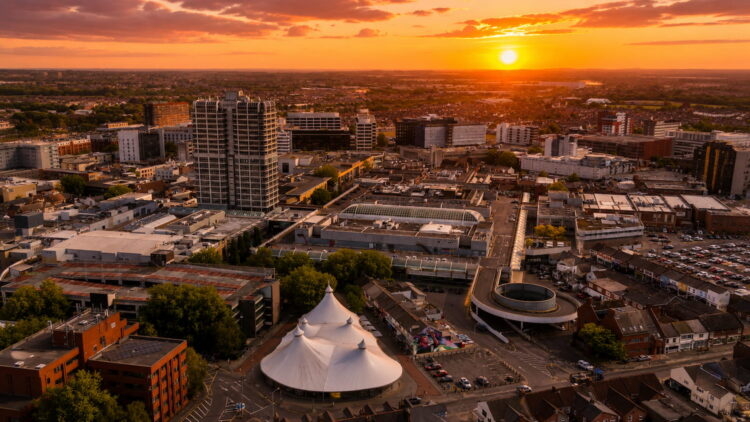

For years, Swindon has occupied an awkward place in Britain’s imagination. It is rarely celebrated in the way Bristol is. It lacks the heritage tourism of Bath, the educational profile of Oxford, or the cultural diversity of Brighton. Yet a major new report suggests that while other places attract the headlines, Swindon may quietly be getting something important right.
According to a new study by Centre for Cities, Swindon is one of just five urban areas in Britain to be classified as “middle-heavy”. Not a reference to the town’s health statistics, but a rare category reserved for places with lower-than-average levels of both deprivation and affluence, meaning the vast majority of residents live in neighbourhoods with stable, middle-ranking living standards.
The report, ‘Uneven Cities: The Geography of Deprivation in Urban Britain’, examined 63 cities and large urban areas across the UK using the government’s Deprivation Index, which measures factors including income, employment, education, health, crime, housing and access to services.
The average British city has 26% of its neighbourhoods ranked among the country’s most deprived areas. Swindon sits comfortably below that benchmark.
While cities such as Blackburn, Bradford, Liverpool and Hull struggle with high levels of deprivation across large parts of their urban areas, the Centre for Cities report places Swindon among just five urban areas in Britain classed as “middle-heavy”, places with relatively low deprivation and little economic polarisation.
At a time when many towns and cities are becoming increasingly divided between wealth and poverty, the data suggests Swindon remains one of the UK’s more balanced and resilient urban economies.

Nor is it a city of extremes. The report identifies 14 cities as “polarised”, places with unusually high concentrations of both deprivation and affluence. These are places where prosperity and hardship often exist side-by-side, sometimes only streets apart. Swindon does not fall into that category either.
Andrew Wells, Swindon Borough Council’s Head of Inward Investment and Inclusive Economy, said the findings showed Swindon to be a “highly balanced and remarkably stable urban economy” and that, “Swindon demonstrates exceptional economic resilience and consistency over time”
The report’s most striking finding is how little Swindon has changed over the past 15 years. While cities such as Luton and Derby have become more deprived, and Oxford and Cambridge have become more affluent, Swindon has remained remarkably stable, maintaining one of the UK’s more balanced local economies.

That stability reflects a local economy that has long been more diverse than many outsiders assume. Manufacturing remains important, but so do engineering, logistics, financial services, technology and professional employment. Unlike towns built around a single dominant industry, Swindon’s economy has evolved through successive waves of investment and adaptation.
The report also arrives at an interesting moment for local politics. After returning to power at Swindon Borough Council, the Conservatives inherit a town that, according to the data, is performing better than many of its peers. But they also inherit a challenge familiar to administrations of all political colours: how do you build on success rather than simply preserve it?
The question facing the new minority administration is whether it can initially point to a small number of visible wins that genuinely change, or even boost, the trajectory of the town, before embedding more longer term strategy.

That could mean applying greater pressure on SevenCapital to accelerate progress at the long-stalled Oasis site and demonstrate ambitions beyond a housing-led scheme. It could mean maintaining momentum behind the Heart of Swindon programme and turning years of plans and consultation into visible change on the ground. It could also mean working collaboratively with Swindon’s Labour MPs to continue attracting investment, securing government backing and bringing new employers to the town.
The Centre for Cities report suggests Swindon starts from a position many places would envy. The challenge now is whether local leaders can convert that advantage into something really ambitious.
The data tells a positive story about where Swindon is today. Whether the town can climb into the ranks of Britain’s standout success stories is a question that will be answered over the next few years.