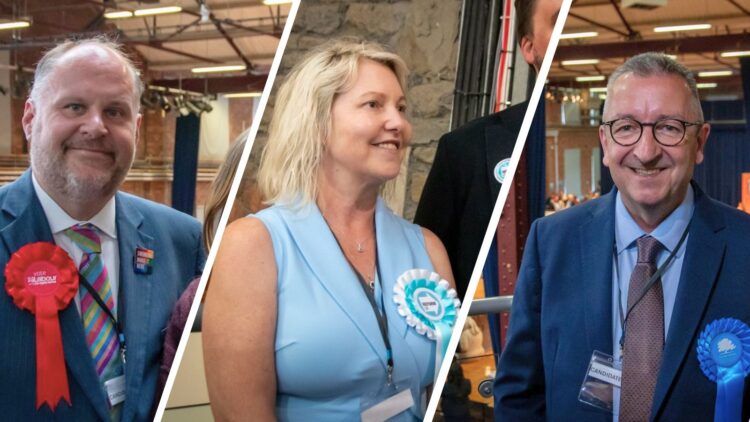

Swindon’s local elections have ended in no overall control, coalition talks and headlines dominated by Reform UK. However, when the total votes cast across the borough are combined, the outcome looks markedly different.
The Conservatives secured the highest number of total votes across Swindon in the 2026 local elections.
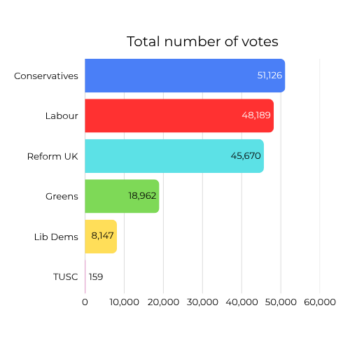
Despite sustained pressure from incumbent Labour councillors and the rapid rise of Reform UK, Conservative candidates amassed 51,126 votes, representing 29.7% of all ballots cast, almost one third of all cast votes.
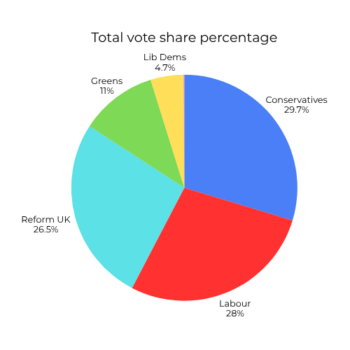
Labour finished second with 48,189 votes, equivalent to 28.0%.
Reform UK placed third borough-wide with 45,670 votes, taking 26.5% of the total.
Overall, 172,253 votes were cast across Swindon. The figures present a political contradiction. The Conservatives won the largest share of the vote and the most seats, yet still did not secure overall control of the council.
Reform UK emerged as the dominant political story of the night, as the first time party in these elections despite finishing third in terms of total votes.
Labour, while losing significant ground in seats, remained close behind in the overall vote tally.
Just 5,456 votes separated the Conservatives in first place from Reform UK in third across the borough.
Although the Conservatives topped the poll, Reform UK’s breakthrough may prove historically significant.
The party secured more than a quarter of all votes cast and converted that support into 14 seats, marking a dramatic shift in Swindon’s political landscape.
In several wards, Reform drew support from both Labour and Conservative voters, reshaping contests and altering outcomes. The result is a level of political fragmentation rarely seen in Swindon.

The Green Party also recorded a notable borough-wide performance. It secured 18,962 votes, accounting for 11% of ballots cast overall and 16% overall in the wards where they stood candidates, but failed to win a seat.
The result underlines the challenges posed by the ward-based system for parties whose support is dispersed rather than concentrated. Taken together, the figures show no single party dominates Swindon politics.

The Conservatives remain the largest electoral force by vote share. Labour retains a substantial base of support. Reform UK has rapidly established itself as a significant challenger.
That near three-way split explains why Swindon now faces negotiations, compromise and the prospect of unprecedented cooperation inside the Civic Offices.