
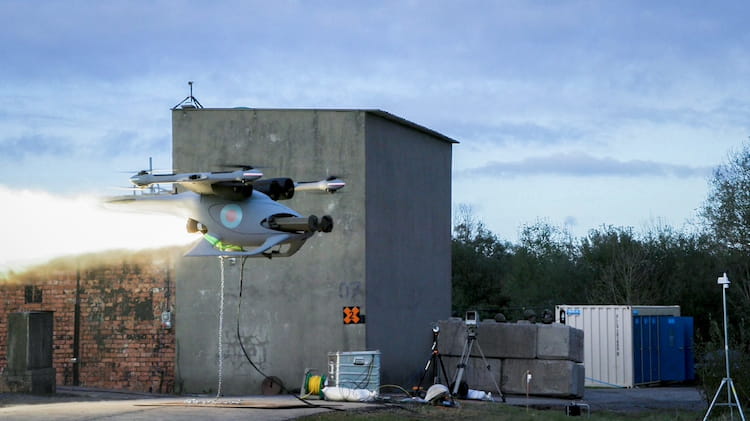

Flyby Technology, founded by Jon Parker, is preparing to establish operations in Swindon as part of its continued expansion into advanced military drone systems and autonomous combat capability.
Parker, who previously flew Buccaneers, Tornados and Sea Harriers during a distinguished RAF career, said the decision to relocate was shaped not by politics, but by a vision for industrial renewal.
“I wasn’t really interested in bringing the company south,” he said. “But when I saw the vision for Swindon, it just captured me.”
After leaving frontline service, Parker went on to fly commercially and later helped integrate aviation systems into the design of HMS Queen Elizabeth and HMS Prince of Wales.
Following a serious accident in 2012 that temporarily left him unable to fly conventional aircraft, he turned his focus to unmanned systems. That pivot led to the rapid growth of Flyby, initially as a high-end training and systems design business rooted in RAF methodology.
The company later developed its own aircraft platform, the Jackal, and has since demonstrated advanced capabilities including the firing of supersonic missiles from a hovering drone.
“We don’t build kit and sell kit,” Parker said. “We sell outcomes.”
He is clear about Flyby’s positioning.
“We’re not interested in aeroplanes that take pictures. We’re not interested in moving parcels. We’re focused on delivering combat effect and deterring threats.”

CHIEF EXECUTIVE OFFICER FlyBy
Flyby had considered several locations, including Yorkshire, where the company has existing links. However, after visiting Swindon and meeting the leadership team, a combination of the local MP Will Stone, and the inward investment team at the council, they concluded the town offered more than geography.
Parker was particularly struck by the site Flyby is moving into, which sits on the former runway of Swindon’s historic Spitfire factory.
For a company rooted in British aerospace heritage, the symbolism mattered.
“There’s a proud industrial story here,” he said. “Industries have drifted away over the years. None of that was the fault of the people of Swindon. If we can play a part in rebuilding something meaningful, that matters.”
The move comes amid growing efforts to position Swindon as a hub for advanced manufacturing and defence-adjacent technology, building on its M4 corridor connectivity and skilled workforce base.
Flyby plans to begin operations in hangar space while scaling towards a larger, highly automated facility described by Parker as a “factory of the future”.
The vision includes significant robotics, multi-disciplinary engineering and the ability to scale production as programmes develop. In the early phase, part of the facility may also provide surge capacity for other companies operating in the sector.
Parker said he is confident Swindon has the technical skills required and, where gaps exist, Flyby will invest in training.
“We’re guests in this town,” he said. “Swindon owes us nothing. We want to contribute.”
For Swindon, Flyby’s arrival represents more than a single company move. It signals participation in a broader shift towards high-value engineering and strategic manufacturing at a time when global security dynamics are evolving.
While Parker acknowledges that defence spending and geopolitics are matters for elected leaders and the electorate, he believes the industrial base must be ready.
“Our responsibility is to ensure that if the country ever needs capability, it’s there,” he said.
If Flyby succeeds in its ambitions, Swindon could once again find itself linked to a chapter of British aerospace history, this time shaped by autonomy, robotics and next-generation combat systems rather than propellers and pistons.
And for Parker, the goal is simple.
“If in five years’ time people say Swindon was the town that attracted a company like ours, then we will have earned that.”













This disgusting man speaks of murder with such ease.
Does Swindon really want to be associated with him?